CASE STUDIES | ARCHITECTURE IN ACTION

From Heritage to High-Finance: Purpose-Built Platforms.

See how we’ve engineered 100% custom-fit platforms for genealogists, tax practitioners and religious leaders – delivering enterprise logic within budget.

What is yóúr requirement?
Book Your Business Architecture Audit

Case study: “JustXhale”

Document Pack Management – DPM

(Platform as a Service – PaaS)

A new type of software application focusing on the processing of document packs following a project management approach. A “document pack” is any collection of various documents required for a specific application or purpose.
Typical use cases are in tax compliance, loan applications and general compliance with the many regulations in South Africa.
https://justxhale.work

  • A Document Process Line designed to manage complex documentation lifecycles where you are dependent on external entities you don’t control.
  • It uses the Case File as the “unit of control“. By treating every case as a mini-project with its own milestones, the business moves from reactive searching to proactive management.
  • The traditional way of handling this employs several applications from spreadsheets, notes, word documents, email and calendars. Finding referenced documents on the run to handle enquiries, is a nightmare.

The Goal:

  • Record admin steps on the fly: Track notes and reminders by user and date on all data entities for complete Case File Timeline Reporting.
  • Move from “Folders” to “Stacks”: Replace nested, disorganized directories with lifecycle-based document stacks – the Case files.
  • Eliminate the “Search Tax”: Ensure the professional spends their time on expertise, not hunting for the latest version of a file.
  • Standardise the “Unit of Production”: Create a predictable cost-per-casefile model that can be billed as a disbursement.
  • Eliminate the ‘Gatekeeper’ Risk: By setting file ownership to a Team rather than an individual, you remove the ‘single point of failure.’ Any trained user can grasp the context and progress of a file in seconds, ensuring the business doesn’t stall when someone is out of the office.

The Architecture:

* Laravel 12 & Vue 3: A modern, decoupled engine for high-speed, app-like performance.
* PostgreSQL Reliability: Strict data integrity to ensure your “Production Units” are never corrupted.
* Multi-Layered Security: Token-based authentication and granular permissions that create absolute “Data Silos” between different subscribers.
* Local Sovereignty: Logic and Databases hosted at Teraco (South Africa) to ensure POPIA compliance and ZAR pricing stability.
* Architect-Led, AI-Assisted: We designed the business logic and data schema first. We then leveraged AI to rapidly build out the standardized components within that framework. This ensured we hit the 70% compression in development time without sacrificing a single industry-standard protocol.
* Maintainable Code: By sticking to DRY (Don’t Repeat Yourself) principles and layered API services, the system is not just a “black box” – it is a robust asset that any Laravel developer can maintain in the future.

Case study: “Vizabiliti Estate Tax Management”

White Labeled SaaS

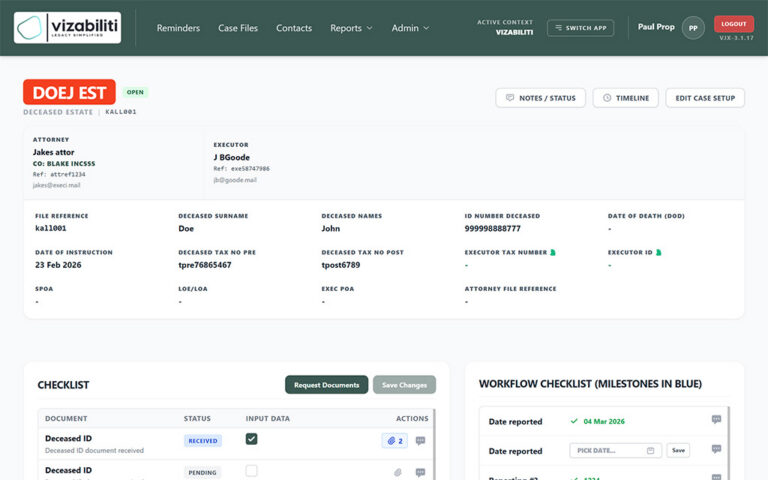
Deceased estate execution is a high-stakes environment involving Tax Practitioners, Executors, Attorneys and SARS. The Tax Practitioner sits in the middle, acting as the sole legal bridge to SARS. We set up Vizabiliti to replace a fragmented “spreadsheet and email” nightmare with a high-velocity production line.
https://vizabiliti.co.za

The Pain Points:

  • External Dependencies: Relying on SARS and external attorneys who operate on their own timelines.
  • Information Fragmentation: Using spreadsheets, notes, word docs and calendars to track a single case.
  • Retrieval Nightmares: Finding a specific SARS reference or document “on the run” to handle an enquiry, was almost impossible.
  • Wasted Headspace: Seconds and minutes lost daily to “context switching” and searching for status updates.

The Requirements:

  • Context-Sensitive Flow: A layout that focuses on the task at hand, limiting clicks and preventing “admin wastage.”
  • Team & Silo Security: Robust privacy between different Tax Practitioner firms (subscribers) and even between internal teams.
  • Resource Agility: The ability to move estates between teams or reallocate staff to different teams as pressure spikes.
  • Precision Tracking: Capturing precise target dates, SARS Case References, and audit trails for every interaction.
  • SLA Reporting: Automated reporting to Executors and Attorneys to prove performance and manage expectations.

Power of PaaS and White-Labelling

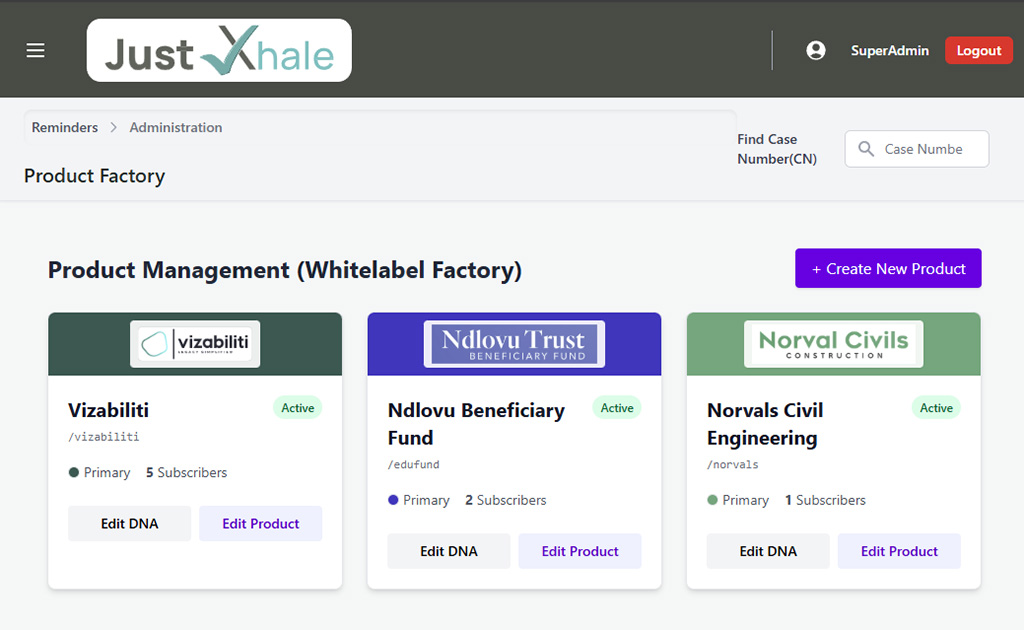
  • The Implementation Reality: Rather than building a SARS-tax solution from scratch—which would have involved months of manual coding and architectural risk – we set Vizabiliti up as a specialized Product on the existing JustXhale PaaS.
  • Pre-built Plumbing: Because the “Engine” (JustXhale) already handled the document stacks, security silos and audit trails, we didn’t have to write a single line of code for the foundation. We simply configured the niche business rules for Deceased Estate Tax. The only aspect that needed some tweaking was configuring the workflow sequence as it required a new way of thinking about their processes . Due to this being on the setup layer only, it will be refined over time.
  • Rapid Deployment: This reduced the take-on process to just a few days – mostly around cleaning up data and adapting it to a relational database structure. We moved straight to solving the business problem without getting bogged down in “building the house” before we could “arrange the furniture.”
  • Because this was built as a product on a standardized PaaS, it is inherently scalable. Since South African Tax Practitioners all operate under the same legal procedures and SARS mandates, Vizabiliti can be resold across the entire sector as a “Plug-and-Play” compliance tool.


The Result: The professional gets a world-class, bespoke-feeling tool at a fraction of the cost of custom development. GTW Software Technologies, the JustXhale Platform Provider – ensures the product is built on a foundation that is 100% stable and maintainable.

Case study: “GeneTree Grave Archives”

Bespoke cloud application

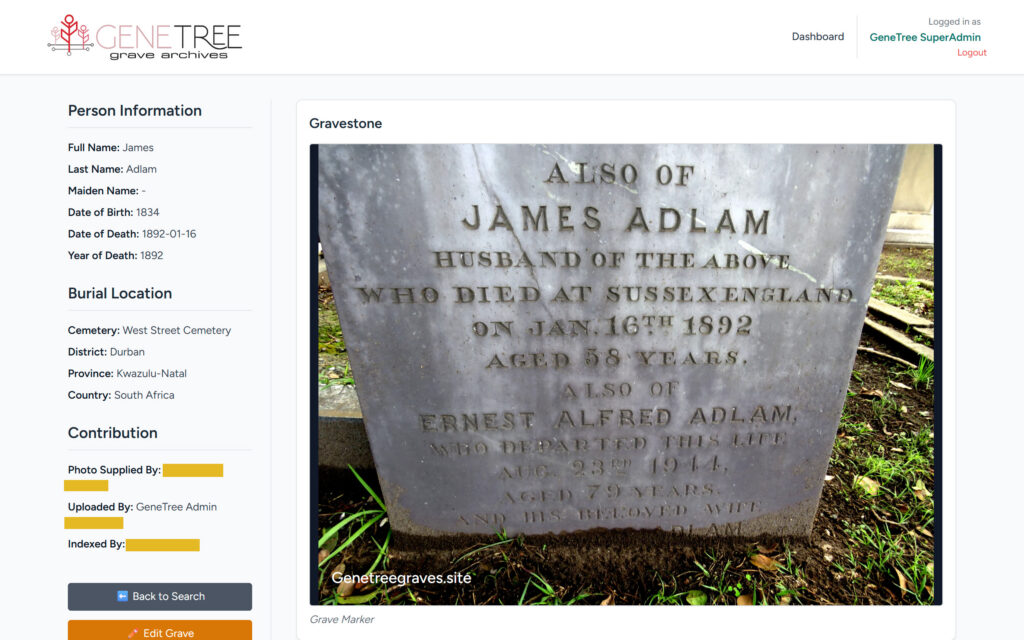
Protecting our cultural heritage including keeping track of our ancestors, is a passionate task facing serious challenges in South Africa. Where municipalities used to keep minute track of graves over 150+ years, those records got destroyed in many towns with massive neglect of graveyards. The widely scattered farm graveyards face similar challenges. This application was built to seamlessly capture and archive these graves.
https://genetreegraves.site/

Pain points:

  • Remote Data Capture: Images are captured in batches in rural areas often lacking mobile signal. The system must allow for direct capture via a Trusted Web App (TWA) or bulk upload from archives, with resizing performed locally in the browser to save bandwidth.
  • The Transcription Gap: Due to weathered inscriptions, AI/OCR proved unreliable. Every record requires manual human transcription, necessitating an interface that prevents “double-editing” and ensures data integrity.
  • Public Accessibility vs. Privacy: The platform must provide a lightning-fast public search (thumbnails/filters) while strictly protecting the geolocation privacy of graves on private land and sensitive documents (Wills/Testaments).
  • Scalability & Cost: With hundreds of thousands of images, traditional cloud storage costs would be prohibitive.

Requirements:

  • Flexible upload: Allow flexible uploading with as little user friction as possible. Provide a Trusted Web App for Android and Progressive Web App usable on IOS.
  • Dual functional layers: Cater for public searches with a very efficient backoffice for managing large numbers of images.
  • User Roles: Control user roles and access to data regarding Create/Edit/Delete and Transcriber/Researcher/Admin functions.
  • Privacy: While capturing geolocation, protect private property at all costs. Many graves are on private land.
  • Layered information: Alow capturing broader history with linked documents and references. Some documents are in the private domain and needs to be protected (Wills/testaments as example).
  • Data Sovereignty/Security: Encryption of all content in transit and at rest. Find an efficient/affordable storage partner with very high levels of redundancy.

The result:

  • Nature of the data: The data structure is very simple requiring a relatively small relational database with a simple cascade. Keeping track of ownership of data was standard by using registration and login along with a role allocation only done by System Admins. Reason being that people needed to be vetted regarding their skill sets for accuracy and also for their reasons for access to the admin layer. The public access to searches and grave records is open.
  • Execution platform: We chose Laravel for its robust “out-of-the-box” security and role-management capabilities. By using a standardized relational database structure with cascading integrity, we ensured that every name, date and document is perfectly cross-linked to its source image.
  • Offline-First Workflow (The “No-Signal” Solution): To solve the lack of field connectivity, the TWA/PWA utilizes Local Browser Storage (IndexedDB). Capturers can continue to photograph and data-tag graves while offline; the system automatically syncs and optimizes the images for upload once a stable connection is re-established.
  • Client-Side Optimization: To reduce data costs – a critical factor in the South African context – we implemented local browser resizing. High-res originals are compressed on the user’s device before upload, significantly reducing wait times and data consumption without sacrificing the legibility of inscriptions.
  • CDN & Global Storage Architecture:
    • The Vault: For high-security storage, images are housed on Backblaze (USA) with strict POPIA adherence. We utilize end-to-end encryption (at rest and in transit), ensuring all decryption keys remain exclusively within South Africa. We selected Backblaze for its industry-leading “11 nines” durability (99.999999999%) – statistically guaranteeing data integrity – and its unmatched cost efficiency compared to traditional hyperscale providers.
    • The Delivery Engine: Through the Bandwidth Alliance, Backblaze integrates seamlessly with Cloudflare’s Content Delivery Network (CDN). Cloudflare acts as our global edge layer, serving images from their Cape Town data centers to eliminate international data lag.
    • The Result: The round-trip from upload to browser availability is highly optimized, typically appearing in under one second on standard South African connections. This architecture provides the perfect balance of US-grade infrastructure durability with local-speed performance and POPIA-compliant sovereignty.

The Result: A high-speed, cost-efficient and culturally significant platform that secures South African history for future generations. The architecture proves that with the right stack, you can achieve global-scale durability with local-speed performance.

Case study: “Church Anywhere”

Church Relationship Management SaaS

South African churches serving the Black Communities have a distributed system with members living in a wide area. They do not have local church buildings as most Western churches and also a lack of management systems and membership databases. They often only have one or two major conferences per year which is the only time that members see each other in larger groups.
https://churchanywhere.co.za

Pain points:

  • The Communication Gap: Church officials often rely on fragmented WhatsApp groups with no central record of member backgrounds or specific pastoral needs.
  • Logistical Chaos: Major annual conferences attract thousands of members with no pre-registration. This places immense strain on venues regarding transport (buses), catering, and accommodation.
  • Data Poverty: Members have limited data budgets and older smartphones, making heavy apps or media-rich websites inaccessible.
  • Compliance Risk: Religious affiliation is “Special Personal Information” under POPIA, requiring banking-grade security and strict access controls.

Requirements:

  • Members: Create a church-branded interface to enahnce their feeling of belonging.
  • Application: It must be mobile first, bandwidth-light and accessible to low-tech members.
  • Church Body: Supply a strong backoffice layer to manage church branch structures, various officials by branch.
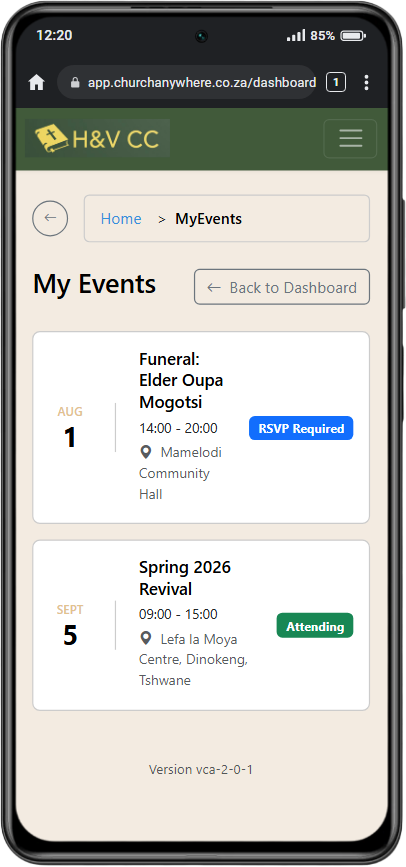
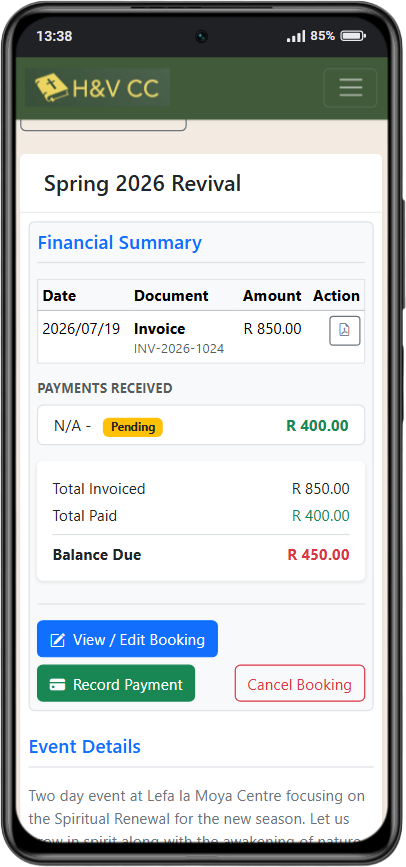
  • Events: Supply an easy to set up and maintain events management system that is also easy to negotiate by members.
  • Messaging: Supply a targeted messaging broadcast system which can split into person-person conversations upon reply.
  • Privacy: Ensure strict adherence to POPIA regulations.

The Solution:

  • We developed Church Anywhere, a Laravel-based platform that replaces administrative guesswork with a robust, role-based management system.
  • The “No-Friction” Member Interface (PWA)
    • Instead of a heavy app store download, we deployed a Progressive Web App (PWA). It is branded to the specific church, bandwidth-light and accessible via a simple URL distibuted to members via Whatsapp initially.
    • WhatsApp Integration: Rather than forcing users into a new chat environment, the system generates “Deep Links” to WhatsApp, keeping conversations in the tool the members already trust.
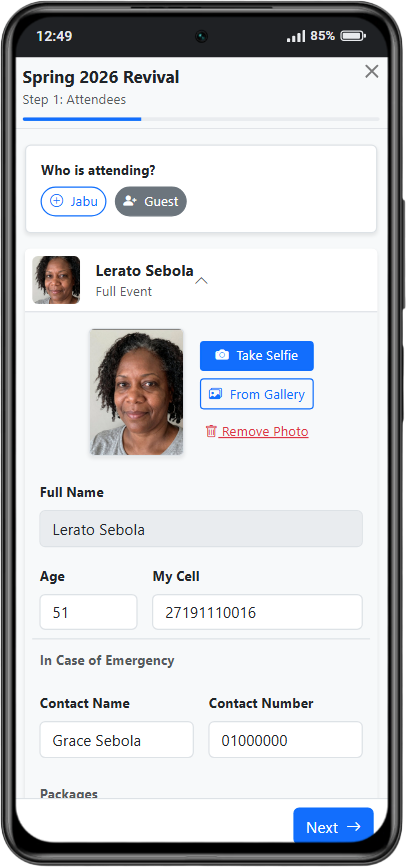
    • Selfie-Security: To manage conference security, members upload a selfie. This provides a visual audit trail for venue entry without requiring expensive biometric hardware.
  • The Logistics Engine (Events & Ticketing)
    • We built a “modular” ticketing system designed for the South African context.
    • Granular Tracking: Organizers can track not just “who is coming,” but who needs a bus from a specific branch, who requires a sleepover and specific dietary needs.
    • Proof of Payment (PoP) Workflow: Recognizing that many members prefer manual EFT or cash deposits, the system allows members to upload a photo of their PoP. This creates a locked audit trail for church auditors without the high fees of integrated payment gateways.
  • The Architecture: Local Speed, Global Durability
    • The Core: The system is hosted locally at Teraco Data Environments (Johannesburg). This ensures that the primary database containing sensitive “Special Personal Information” stays on South African soil for maximum POPIA alignment and “zero-lag” performance.
    • The Edge: Member selfies and backups are stored on Backblaze (USA) via Cloudflare’s Cape Town CDN. This ensures that image-heavy profiles load instantly on mobile devices while keeping storage costs a fraction of traditional cloud providers.
    • Security: All data is encrypted at rest and in transit. Role-based access ensures that a Branch Official only sees their specific members, while the National Admin maintains a bird’s-eye view.

The Result: A secure, flexible, and culturally-aligned platform that bridges the gap between ancient faith and modern management. Church leaders now have a clear “operational picture” of their congregation, while members enjoy a deeper sense of belonging through a platform that respects their data and their devices.

Ready to build a system that actually works for you?

Get a 100% custom roadmap designed for your exact business logic.